
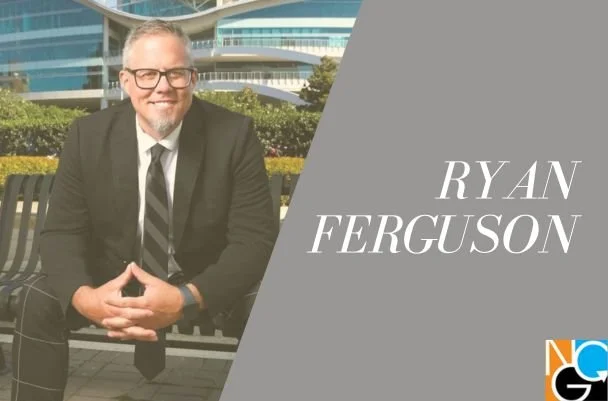
When did Ryan Ferguson realize he’d made the right career move?
It wasn’t a KPI dashboard or a big client win.
It was his wife, noticing something small.
“My wife was like, it’s so nice that you actually smile when you come home. So I knew I made the right decision.”
Ryan tells that story while reflecting on leadership training through NextGen Center, and it lands because it’s honest. Leadership, for him, is not just about managing work. It shows up at home. It changes the way you carry yourself.
And, if we’re being real, Ryan didn’t start this program as a believer.
He started it as a skeptic.
A leader with a lot of miles on the road
Ryan is Vice President of Client Service at Go Forth Marketing. Before that, he worked at NASCAR for over a dozen years, running experiential marketing, sponsorship activation, and hospitality for major brands.
Then life happened in the way it often does. He got married, started a family, and the constant travel stopped working for him. “I was going 26, 30 races a year. I was like, I can’t do that.”
He then moved into a marketing manager role for the City of High Point, helped rebrand the city, and saw that work recognized at a global level. Then came Go Forth, where he stepped into leadership with a clear goal: take weight off the owner’s shoulders and help build the organization.
So yes, Ryan has leadership experience. And yes, he has sat through a lot of leadership classes.
“No less than 300,000 leadership classes,” he jokes, especially in the public sector where it can feel like “one class fits all.”
That's an important context for what happens next.
Low expectations
Ryan didn’t sign up for NextGen Center because he was eager.
He was enrolled by leadership at Go Forth, many of whom had personal experience. And at first, he was not happy about it; he’s already seen every version of “how to sandwich a situation” and “how to take a look at goals.”
And the virtual format made him even more skeptical. Ryan is a “one-to-one person.” He likes feeling the energy in the room. So the idea of “sit[ting] behind a computer screen for eight hours” sounded like torture.
“It was 1000% not that,” Ryan says.
The first day changed the whole story
He expected a lecture. Instead, he felt engaged. Involved. Like everyone was “in the same room,” even through the screen.
The design of the program wasn’t passive listening. It was participation. People worked with each other and built relationships in real time.
When that first day ended, he surprised himself.
“That was a lot quicker than I thought it was going to be, and I didn’t really feel what I thought. I was extremely impressed.”
Brian Alvo didn’t teach at them. He facilitated along with them.
Ryan describes Brian as the opposite of the “sit here and listen to me” model.
From the start, it was a two-way conversation, always: “This is where we’re at. What do you guys think?”
That line matters because it explains why Ryan bought in. Brian didn’t hand out answers. He “giv[es] us the space to create those ideas on our own and bounce those ideas off of others,” while still interjecting his experience when it helps.
Ryan’s summary is simple and telling:
“It wasn’t a matter of Brian saying, “Sit here and listen to me, because I am all knowledgeable.” It was more “listen to each other.”
The moment he couldn’t unsee
When asked about an “aha moment,” Ryan doesn’t point to a shiny new framework. He points to the deeper work underneath most leadership advice: culture, goals, and actually living by them.
“Did you really write them down on paper? Do they live on your wall, and are you living and working by them? Are you standing up for them?”
Ryan calls himself a “big proponent of building a foundation.” Then he describes what the cohort helped reinforce: once you have that foundation, you can point to a North Star.
It wasn’t abstract. It was practical. It connected to client work, internal conflict, and even his personal life.
The shift in his leadership style was quieter than you’d expect
Ryan doesn’t say the program replaced his leadership instincts.
“It wasn’t so much the techniques,” he explains. It was looking at his process and asking, “How do I connect this process to maximize what I was doing?”
That reflection gave him direction. It helped him “fill in all those gaps” and move forward with more intention.
He also reframes what “growth” means in a leadership program. You don’t come out as “the best leader in the entire world.” It’s still a process. It’s a guide. You make it your own.
And for Ryan, “making it your own” is the whole point.
He tells skeptics: yes, some content will sound familiar. But the difference is that you take the base guide and make it yours. He was able to “make it Ryan Ferguson. It’s not Brian’s, but Ryan.”
There was a day Ryan walked out of the session and his boss could tell something was different. She asked him if he was alright.
And Ryan told her, “Today was pretty serious. We all got really vulnerable.”
His boss didn’t flinch. She remembered that day from her own experience with NextGen Center, and told him it was good he could do that with “like-minded people.”
Why stay connected to NextGen Center
Ryan is all about connection. He’s still calling classmates, grabbing coffee, and treating the cohort like a long-term network, not a one-time class.
He says it directly: “If you’re not learning every single day, then what are you doing?”
And he’s already recommending the program inside his organization. One reason is personal growth. The other is the ripple effect. Because when leadership development works, it changes more than your meetings.
It changes the way you come home.